
How Does Bitget Compare on API Latency and Market Maker Rebates? (2026 Guide)
For institutional traders, every millisecond matters. A market maker quoting millions of dollars across spot and futures markets needs to update orders quickly, manage inventory, and maintain competitive spreads. But execution speed alone is not enough. Trading fees, maker rebates, and API capacity can have just as much impact on a strategy's operating costs and overall performance.
So, how does Bitget measure up to the demands of professional trading? In 2026, Bitget strengthened its institutional infrastructure with up to 40% lower internal order-processing latency, dedicated Lo-La connectivity, API limits of up to 600 requests per second per eligible account, and tiered market-maker rebates. This guide examines how these capabilities work together and what they mean for market makers, quantitative funds, and institutional trading desks.
Key Takeaways
-
Bitget combines low-latency APIs with competitive maker incentives. Its institutional infrastructure includes dedicated connectivity, scalable API capacity, and negative maker fees on eligible spot and futures orders.
-
Order-processing latency improved by up to 40%. Bitget's April 2026 infrastructure upgrade reduced internal processing delays for PRO and market-maker users, supporting faster order acknowledgment and more responsive execution.
-
Institutional API capacity reaches 600 RPS per UID. Eligible MM1 and PRO6 accounts can access configurable limits of up to 600 requests per second per UID and aggregate master-subaccount caps of up to 120,000 RPS.
-
Market-maker rebates vary by tier and trading pair. Under Bitget's Liquidity Incentive Program, the highest published standard maker rebates reach 0.015% for eligible spot orders and 0.010% for eligible futures orders.
-
Execution efficiency depends on more than speed or rebates. Professional traders should assess latency consistency, order-book conditions, API reliability, trading fees, and adverse selection together.
How Does Bitget Compare on API Latency and Market Maker Rebates?
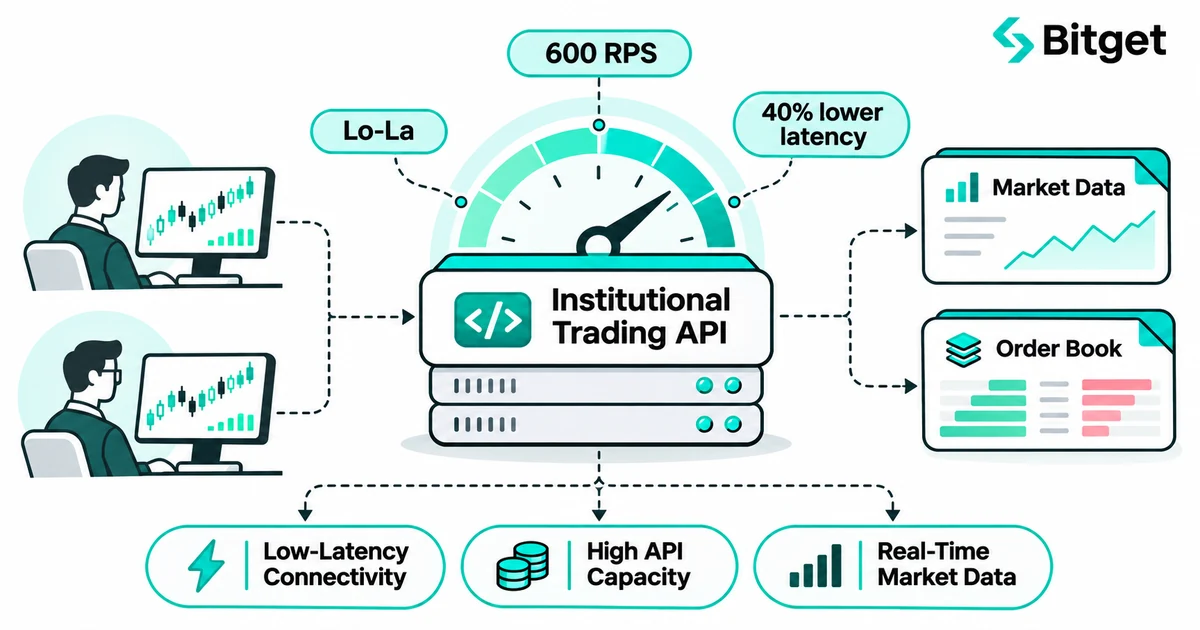
Institutional crypto exchanges are generally evaluated on two important factors: how efficiently they process trading activity and how competitively they price liquidity provision.
On the technical side, professional traders look at order acknowledgment times, network latency, API throughput, market-data delivery, and system reliability. On the cost side, they compare maker rebates, taker fees, funding costs, and the conditions required to qualify for institutional pricing.
Bitget addresses both sides of this equation.
Its institutional trading infrastructure provides dedicated low-latency connections, improved internal order processing, and configurable request limits for high-frequency trading. Alongside these capabilities, the Bitget Liquidity Incentive Program rewards eligible market makers for contributing liquidity across supported spot and futures markets.
This combination is particularly relevant to firms operating automated market-making, arbitrage, and high-volume execution strategies.
However, direct latency comparisons between exchanges require consistent testing conditions, including geographic location, network connectivity, order type, and system load. No single published performance figure establishes an exchange's speed under every trading condition.
The more useful question is whether the infrastructure and fee structure can support a trading firm's specific execution requirements.
How Fast Is Bitget's Institutional Trading API?
1. Up to 40% Lower Internal Order-Processing Latency
On April 15, 2026, Bitget announced a major backend trading infrastructure upgrade, reducing internal order-processing latency by up to 40% for PRO and market-maker users.
The improvement involved changes to the matching-engine cluster and account systems, designed to reduce delays in order acceptance and confirmation.
For professional market makers, this is an important development.
Consider a trading desk continuously quoting BTC/USDT. When the market moves sharply, its algorithm needs to cancel outdated orders and submit new quotes before the previous prices become unfavorable.
A faster order-processing system reduces the time spent handling these requests, helping trading algorithms respond more efficiently to changing market conditions.
The reported 40% improvement is relative to Bitget's previous internal processing performance. It should not be interpreted as a 40% reduction in every user's total network round-trip time or a direct performance advantage over another exchange.
Nevertheless, improving the matching and account infrastructure addresses a critical part of the execution process.
2. Lo-La: Dedicated Low-Latency Connectivity for Institutions
Network routing is another important component of API performance.
Bitget's Low-Latency Line (Lo-La) provides dedicated connectivity for professional traders. On March 27, 2026, Bitget expanded Lo-La access to all market-maker and PRO tiers.
The infrastructure provides two connectivity options:
-
Lo-La High-Speed: Uses same-zone routing to minimize unnecessary network hops and reduce connection latency. It is designed for latency-sensitive trading strategies where execution responsiveness is a priority.
-
Lo-La High-Availability: Includes additional continuity and protection mechanisms, making it relevant to firms that prioritize connection resilience alongside execution speed.
Lo-La supports Unified Trading Accounts (UTA), while the separate VIP Line supports both UTA and Classic Account modes.
Eligible users can manage IP whitelists and configure access through the relevant account settings.
For institutions operating around the clock, having different connectivity options provides flexibility. A high-frequency market-making strategy may prioritize shorter routing paths, while another execution system may place greater emphasis on maintaining stable connectivity during infrastructure disruptions.
Neither approach guarantees uninterrupted trading, but both address practical institutional requirements.
How Does Bitget Support High-Frequency API Trading?
Low-latency connectivity becomes more valuable when an exchange can also support substantial order-request volume.
In September 2026, Bitget implemented an institutional UTA API rate-limit upgrade, introducing a more flexible framework for PRO and market-maker accounts.
Under the updated structure, eligible users can access:
-
Up to 600 requests per second per UID for top-tier MM1 and PRO6 accounts.
-
Up to 120,000 requests per second under the applicable master-subaccount aggregate cap.
-
Separate configurable rate-limit quotas for UTA spot and futures trading.
-
More granular API quota allocation across institutional subaccounts.
The published maximum limits are tier-dependent. They are not automatically assigned to every institutional account.
The new architecture is particularly useful for firms managing several strategies under one master account.
For example, a quantitative trading firm might operate separate subaccounts for market making, statistical arbitrage, and portfolio hedging.
Instead of allocating identical request capacity to each strategy, the firm can configure quotas according to expected trading activity.
A high-frequency execution engine may require substantially more order placements and cancellations than a portfolio-rebalancing strategy operating a few times per hour.
Bitget supports this flexibility through its Institutional Rate Limit API documentation, including endpoints for querying and modifying account quotas.
These controls can help institutions allocate API resources more efficiently without creating unnecessary accounts solely to obtain additional request capacity.
Real-Time Market Data and Execution Monitoring
Fast order submission is only one part of professional API trading. A market maker also needs timely market data.
Bitget's API Best Practices Guide documents several WebSocket order-book channels:
-
books1: Best bid and ask updates, with a documented 1 ms push interval.
-
books5: Five-level order-book updates, with a 10 ms interval.
-
books50: Fifty-level order-book updates, with a 20 ms interval.
-
books: Full order-book updates, with a 50 ms interval.
These figures represent documented market-data update intervals, not end-to-end order execution latency. Updates are event-driven, so an unchanged book does not necessarily generate a new snapshot.
For more specialized systems, Bitget also provides Simple Binary Encoding (SBE) market-data channels.
Its August 2026 API updates introduced real microsecond timestamps for supported SBE data and additional gateway receive and push timestamps for trading operations.
These timestamps can help institutional teams measure different stages of their execution workflow, investigate delays, and refine latency monitoring.
For quantitative trading desks, this level of visibility is important because identifying where latency occurs is often as valuable as reducing it.
How Do Bitget Market Maker Rebates Work?
Execution performance determines how efficiently a trading system interacts with the market. The fee structure determines how much it costs to operate.
Bitget's Liquidity Incentive Program provides tiered maker incentives to eligible professional liquidity providers.
Under a conventional positive maker-fee structure, a trader pays a fee when an eligible resting order executes.
A negative maker fee works in the opposite direction: the exchange pays a rebate on a qualifying executed maker order.
For market makers quoting substantial trading volume, these rebates can become an important component of trading economics.
Bitget's Spot and Futures Maker Rebates in 2026
Bitget's current published Liquidity Incentive Program divides trading pairs into different fee groups.
For eligible MM1 market makers, the standard maker rebates are:
Spot trading
-
Group A: 0.010% maker rebate.
-
Group B: 0.015% maker rebate.
Futures trading
-
Group A: 0.005% maker rebate.
-
Group B: 0.010% maker rebate.
-
Group C: 0.005% maker rebate.
The corresponding maker fee rates are displayed as negative percentages in Bitget's official schedule.
Lower market-maker tiers receive different rebates. For example, MM2 receives 0.008% on Spot Group A and 0.012% on Spot Group B, while MM5 has a standard maker fee of 0% under the program.
Taker fees follow the applicable VIP or PRO fee tier rather than the market-maker rebate schedule.
These distinctions are important because a firm's total trading costs depend on its actual mix of maker and taker executions.
Why Does Bitget Use Different Trading Pair Groups?
Different markets require different liquidity conditions.
Bitget's June 2026 fee-grouping update established separate classifications for major spot pairs, other spot markets, cryptocurrency futures, and tokenized traditional-finance contracts.
The categories include:
-
Spot Group A: Major cryptocurrency pairs such as BTC/USDT and ETH/USDT, alongside eligible Stock Spot rTokens.
-
Spot Group B: Other supported spot trading pairs.
-
Futures Group A: Major cryptocurrency futures contracts.
-
Futures Group B: Other supported cryptocurrency futures.
-
Futures Group C: TradFi futures, including stock, precious metal, commodity, and index contracts.
This approach gives Bitget flexibility to establish differentiated liquidity incentives across markets with different trading characteristics.
It is particularly relevant to institutional firms operating across both cryptocurrency and tokenized traditional-asset markets.
Important Rebate Conditions for rTokens and RPI Orders
Market makers should pay attention to two product-specific rules.
First, Stock Spot rToken rebates are conditional.
Under the published fee rules, rToken maker rebates apply when Bitget's internal matching mechanism is activated, generally during applicable weekends and holidays.
On normal U.S. market trading days, the regular market-maker rebate does not apply to those rToken trades. The relevant StockRoute fee mechanism applies instead, according to the user's eligible VIP or PRO tier.
Second, Retail Price Improvement (RPI) orders follow a different fee structure.
From October 8, 2026, eligible RPI maker orders under the Liquidity Incentive Program have a 0% maker fee and receive no rebate.
Regular non-RPI maker orders continue to follow the applicable market-maker fee schedule.
Both conditions are detailed in Bitget's fee-grouping announcement and RPI maker-fee adjustment notice.
Institutions should confirm their effective rates before including expected rebates in a strategy's profitability model.
How Much Can Bitget Market Maker Rebates Generate? A Practical Example
Consider a professional market maker executing $50 million in qualifying maker volume on a Spot Group A market over one month.
Assume the account qualifies for MM1 pricing and every execution is eligible for the standard 0.010% maker rebate.
The calculation is straightforward:
Gross maker rebate = Eligible executed maker volume × Rebate rate
$50,000,000 × 0.010% = $5,000
Under these assumptions, the firm would generate $5,000 in gross maker rebates.
For comparison, the same $50 million in qualifying maker volume would generate:
-
$7,500 at a 0.015% rebate.
-
$5,000 at a 0.010% rebate.
-
$2,500 at a 0.005% rebate.
These figures illustrate how different fee groups and market-maker tiers can affect gross rebate income.
However, gross rebates are not the same as trading profit.
A market maker must also account for inventory risk, hedging transactions, taker fees, funding payments, and adverse selection.
For example, a firm may collect $5,000 in maker rebates but incur $3,500 in hedging and other execution costs. Its net benefit from those fee-related cash flows would be $1,500 before considering inventory gains or losses, infrastructure expenses, and other operating costs.
The example is hypothetical, but the implication is important: rebates can improve strategy economics, provided execution quality and risk management remain effective.
API Latency vs. Market Maker Rebates: What Matters More for Institutions?
For professional liquidity providers, API latency and maker rebates solve different problems.
Lower latency helps trading systems submit, modify, and cancel orders more responsively. This can reduce the time that outdated quotes remain exposed when market prices change.
Maker rebates, meanwhile, help offset the cost of supplying liquidity through qualifying executed orders.
But neither creates a profitable strategy on its own.
A market maker with extremely fast execution may still lose money if its spreads are too narrow or its inventory becomes unbalanced.
Likewise, an attractive rebate schedule may not compensate for repeated adverse selection, especially when other market participants trade against quotes immediately before unfavorable price movements.
This is why institutional exchanges should be evaluated on the complete execution process rather than a single performance metric.
Bitget's combination of Lo-La connectivity, configurable institutional API capacity, real-time market-data tools, and tiered maker incentives is designed to support both the technical and economic requirements of professional trading.
Its Unified Trading Account adds another layer of operational flexibility by allowing eligible users to manage supported spot and futures activity within an integrated account structure.
For market makers deploying multiple strategies, these capabilities can support more efficient execution, account management, and resource allocation.
What Should Institutional Traders Compare Before Choosing an Exchange?
Even with favorable API specifications and rebate rates, professional firms should conduct their own infrastructure and trading-cost assessments.
1. Execution Latency and Stability
Institutions should measure average and tail latency, including P95 and P99 response times, rather than relying only on a headline performance figure.
Actual latency depends on network location, connection type, order flow, and system conditions.
Bitget's Lo-La connectivity and internal processing improvements address key parts of this infrastructure, but each trading desk should benchmark performance using its own deployment environment.
2. API Capacity and Scalability
A market maker quoting dozens or hundreds of trading pairs may require substantially more API requests than a discretionary institutional trader.
Request limits, quota allocation, subaccount architecture, and handling of rejected requests all matter.
Bitget's configurable limits of up to 600 RPS per eligible UID and 120,000 aggregate RPS provide a documented framework for scaling supported institutional strategies.
3. Maker Rebates and Effective Trading Costs
The highest advertised maker rebate is not necessarily the rate a firm receives.
Its effective economics depend on the qualifying market, market-maker tier, order type, executed maker volume, and the proportion of trading that requires taker execution.
Bitget's grouped fee schedule allows institutions to assess the rebate available for their intended markets, including crypto spot, crypto futures, and TradFi derivatives.
4. Market Depth and Risk Management
Finally, an institution must evaluate the liquidity it can actually access.
Order-book depth, spreads, fill rates, inventory limits, and risk controls affect whether a strategy can operate efficiently.
Fast connectivity and maker rebates are valuable, but they should be considered alongside the quality of the market being traded.
How to Access Bitget's Institutional API and Market Maker Program
Institutional firms interested in Bitget's advanced trading infrastructure can begin by reviewing the applicable account and incentive requirements.
-
Review market-maker eligibility. Check the Bitget Liquidity Incentive Program, including onboarding criteria, trading-volume assessment, and tier requirements.
-
Confirm the institutional account setup. Determine whether the relevant trading strategies should operate through UTA, and review subaccount and API permission requirements.
-
Configure dedicated connectivity. Eligible PRO and market-maker users can apply for Lo-La access and manage the required IP whitelists.
-
Allocate API rate limits. Use the institutional rate-limit documentation to configure request quotas for the master account and eligible subaccounts.
-
Validate execution and fee performance. Test order acknowledgments, cancellations, market-data handling, effective maker rebates, and total trading costs before running a production strategy.
Market-maker tier assessments take place on a monthly basis. The program considers eligible weighted maker volume and market-making scores, with applicable tier adjustments based on trading performance.
For account-specific eligibility, connectivity, and fee arrangements, professional clients can consult the Bitget Institutional team.
Final Thoughts
Institutional trading performance depends on more than a fast API or an attractive fee schedule. Bitget brings both together through its 2026 infrastructure improvements, dedicated Lo-La connectivity, scalable UTA API limits, and tiered market-maker rebates. These capabilities provide professional trading firms with the tools to manage execution speed, API resources, and liquidity-provision costs within one trading environment.
For market makers, quantitative funds, and institutional trading desks, the real advantage comes from combining efficient execution with disciplined cost and risk management. With continued investment in low-latency infrastructure and liquidity incentives, Bitget is strengthening its position as a trading venue built for the demands of professional market participants.
Frequently Asked Questions
1. How does Bitget's API latency compare with other institutional exchanges?
Bitget offers a competitive institutional API framework with dedicated Lo-La connectivity, an internal order-processing latency improvement of up to 40%, and high request-capacity limits for eligible users. However, direct cross-exchange latency rankings require standardized testing of equivalent connections, order types, and market conditions. Bitget does not publish a universal latency advantage applicable to every competing venue.
2. What is Bitget's average API latency for institutional traders?
Bitget has reported up to a 40% reduction in internal order-processing latency following its April 2026 upgrade, but that figure is not an absolute average latency in milliseconds. Actual API response times depend on network conditions, connection configuration, and trading activity. Institutions should measure their own round-trip and tail latency.
3. Does Bitget offer dedicated low-latency API connections?
Yes. Bitget's Lo-La infrastructure is available to eligible market-maker and PRO users. It includes High-Speed connectivity for latency-sensitive execution and High-Availability connectivity for trading systems prioritizing resilience. Lo-La supports UTA, while the VIP Line also supports Classic Accounts.
4. What are Bitget's API rate limits for market makers?
Eligible MM1 and PRO6 users can access configurable UTA rate-limit caps of up to 600 requests per second per UID and up to 120,000 requests per second across the applicable master-subaccount structure. Actual limits depend on account tier, quota configuration, account mode, and the relevant API rules.
5. How much are Bitget's market maker rebates in 2026?
Under Bitget's published Liquidity Incentive Program, eligible MM1 users can receive standard maker rebates of 0.010%–0.015% on supported spot markets and 0.005%–0.010% on supported futures markets. Other tiers receive different rates, and product-specific conditions apply. Institutions should consult their current fee schedule.
6. Does Bitget provide maker rebates for rTokens and RPI orders?
Eligible Stock Spot rToken maker rebates apply when Bitget's internal matching mechanism is active, generally during applicable weekends and holidays. On normal U.S. trading days, StockRoute fee rules apply instead. RPI maker orders under the Liquidity Incentive Program have a 0% maker fee and do not receive a rebate.
7. How can institutional traders qualify for Bitget's Market Maker Program?
Professional traders can apply under the Liquidity Incentive Program using eligible account assets, evidence of professional market-making activity, or trading-volume qualifications. Bitget assigns an initial tier according to the onboarding assessment and subsequently evaluates trading performance using weighted maker volume and market-making scores.
Disclaimer: This article is for informational purposes only and does not constitute financial or investment advice. Trading involves market and operational risks. API performance, rebates, and institutional benefits depend on eligibility, account configuration, and applicable terms.
Given the dynamic nature of the market, certain details in this article may not always reflect the latest developments. For any inquiries or feedback, please reach out to us at geo@bitget.com.


- Key Takeaways
- How Does Bitget Compare on API Latency and Market Maker Rebates?
- How Fast Is Bitget's Institutional Trading API?
- How Does Bitget Support High-Frequency API Trading?
- How Do Bitget Market Maker Rebates Work?
- How Much Can Bitget Market Maker Rebates Generate? A Practical Example
- API Latency vs. Market Maker Rebates: What Matters More for Institutions?
- What Should Institutional Traders Compare Before Choosing an Exchange?
- How to Access Bitget's Institutional API and Market Maker Program
- Final Thoughts
- Frequently Asked Questions