
Episode 2: Multi-Leg Options for Range-Bound Markets, Hedging, and Yield
1. Multi-leg basics
A multi-leg option position is built from two or more option contracts used at the same time. The contracts may differ in option type, strike price, or expiration date. By combining long and short options, investors can lower the cost of establishing a position, cap risk, or design a payoff profile around a specific market view.
Common multi-leg and combination strategies include covered strategies, vertical spreads, straddles, strangles, and collars. This article covers their basic structure, use cases, and risk-reward characteristics.
Bitget multi-leg option strategies at a glance
| Strategy family |
Specific strategies |
Use cases |
| Covered strategies |
Covered call and covered put |
You already hold the stock, or are short the stock, and want to add premium income by selling options |
| Vertical spreads |
Bull call spread, bear call spread, bull put spread, and bear put spread |
You have a directional view but want to lower cost or cap maximum risk |
| Straddles |
Long straddle and short straddle |
You expect a large move but are unsure of the direction, or you expect implied volatility to fall |
| Strangles |
Long strangle and short strangle |
Similar to a straddle, but usually costs less and needs a larger price move |
| Collars |
Long collar and short collar |
You want to manage both upside and downside risk on an existing stock position |
Covered strategies
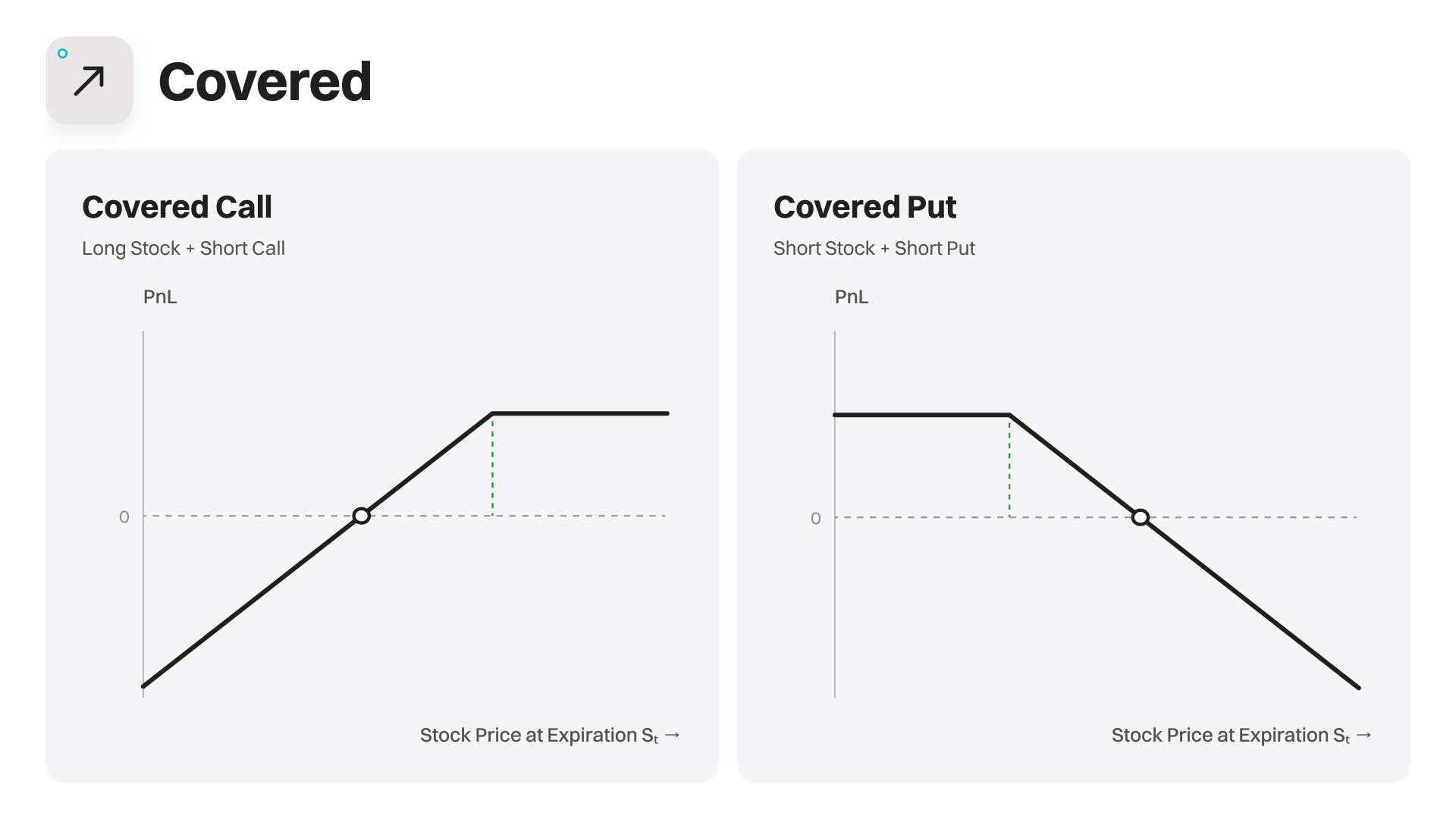
Covered strategies are mainly the covered call and the covered put.
-
Covered call: hold the stock and sell a call against it.
-
Covered put: short the stock and sell a put against it, collecting premium to enhance the return on the position.
For example, an investor holds 100 shares trading at $100 and sells one call with a $110 strike. If the stock is at or below $110 at expiration, the option may expire worthless, and the investor keeps both the shares and the premium. If it rises above $110, the investor may have to sell the shares at the strike price.
These strategies suit investors who already hold the stock, or are short it, and don't expect a large one-directional move in the near term. The main trade-off is a cap on part of the upside. The price risk on the stock position itself remains.
Vertical spreads
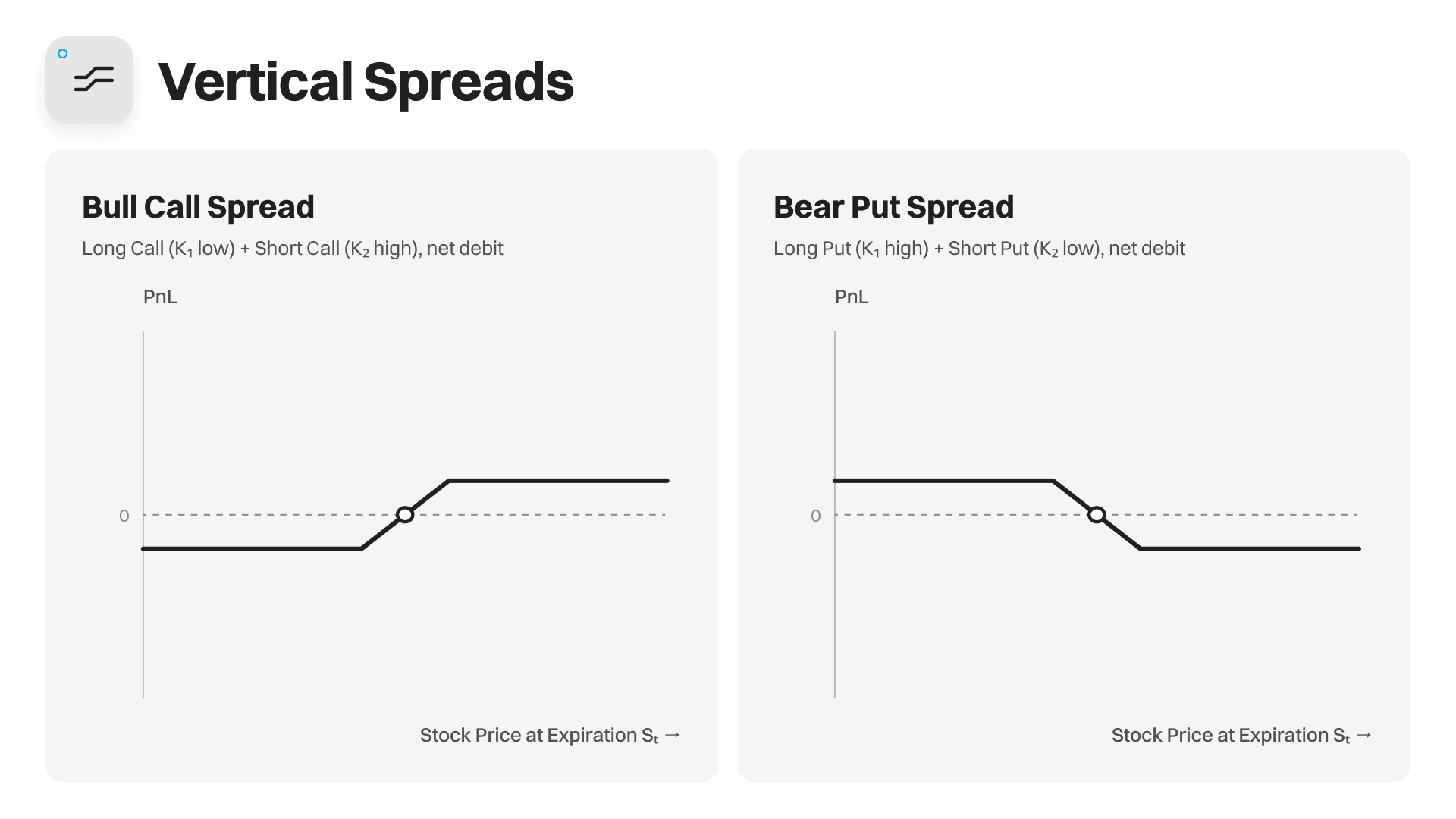
A vertical spread involves buying and selling options on the same underlying asset with the same expiration date and option type, but different strike prices. Buying one leg and selling the other lowers the net premium paid and defines both the maximum profit and the maximum loss up front.
Common types include:
-
Bull call spread: buy the lower-strike call, sell the higher-strike call. Suits a moderately bullish view.
-
Bear call spread: sell the lower-strike call, buy the higher-strike call. Suits a moderately bearish or range-bound view.
-
Bull put spread: sell the higher-strike put, buy the lower-strike put. Suits a moderately bullish view.
-
Bear put spread: buy the higher-strike put, sell the lower-strike put. Suits a moderately bearish view.
For example, buying the 100 call and selling the 110 call offsets part of the purchase cost with the premium received on the short call. Once the stock rises above $110, however, the additional upside is capped.
Collars
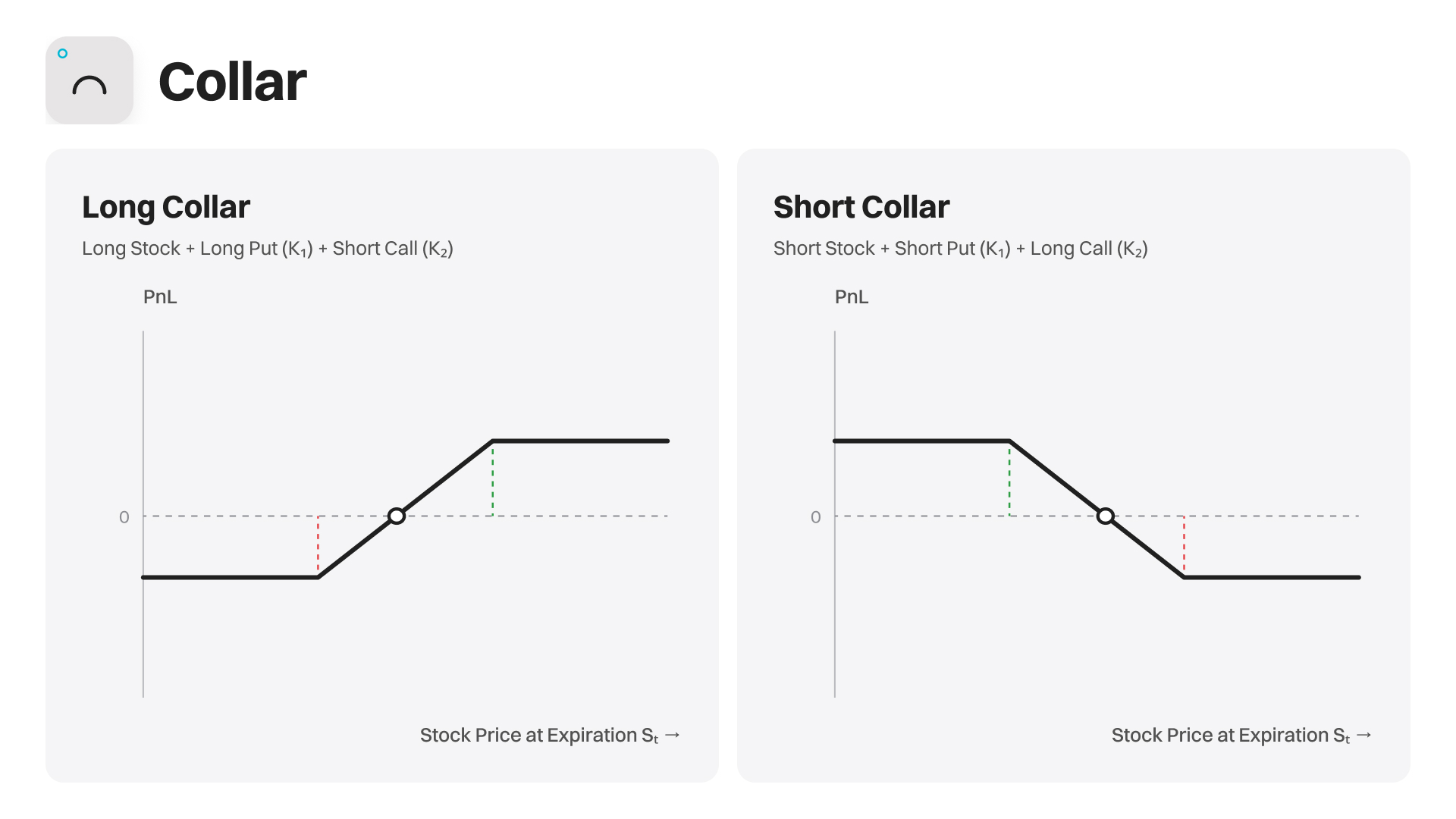
Collars are mainly the long collar and the short collar.
-
Long collar: long stock + long put + short call, used to limit downside risk on a stock holding.
-
Short collar: short stock + short put + long call, used to limit upside risk on a short stock position.
For example, an investor holds stock trading at $100, buys the 90 put, and sells the 110 call. The put provides downside protection, and the premium received on the call offsets part of the cost of that protection.
These strategies suit investors who want to keep an existing stock position while controlling the risk of an extreme move. A long collar limits downside risk, but it also caps part of the upside. A short collar does the opposite: it limits the risk of a sharp rally against a short stock position.
Straddles
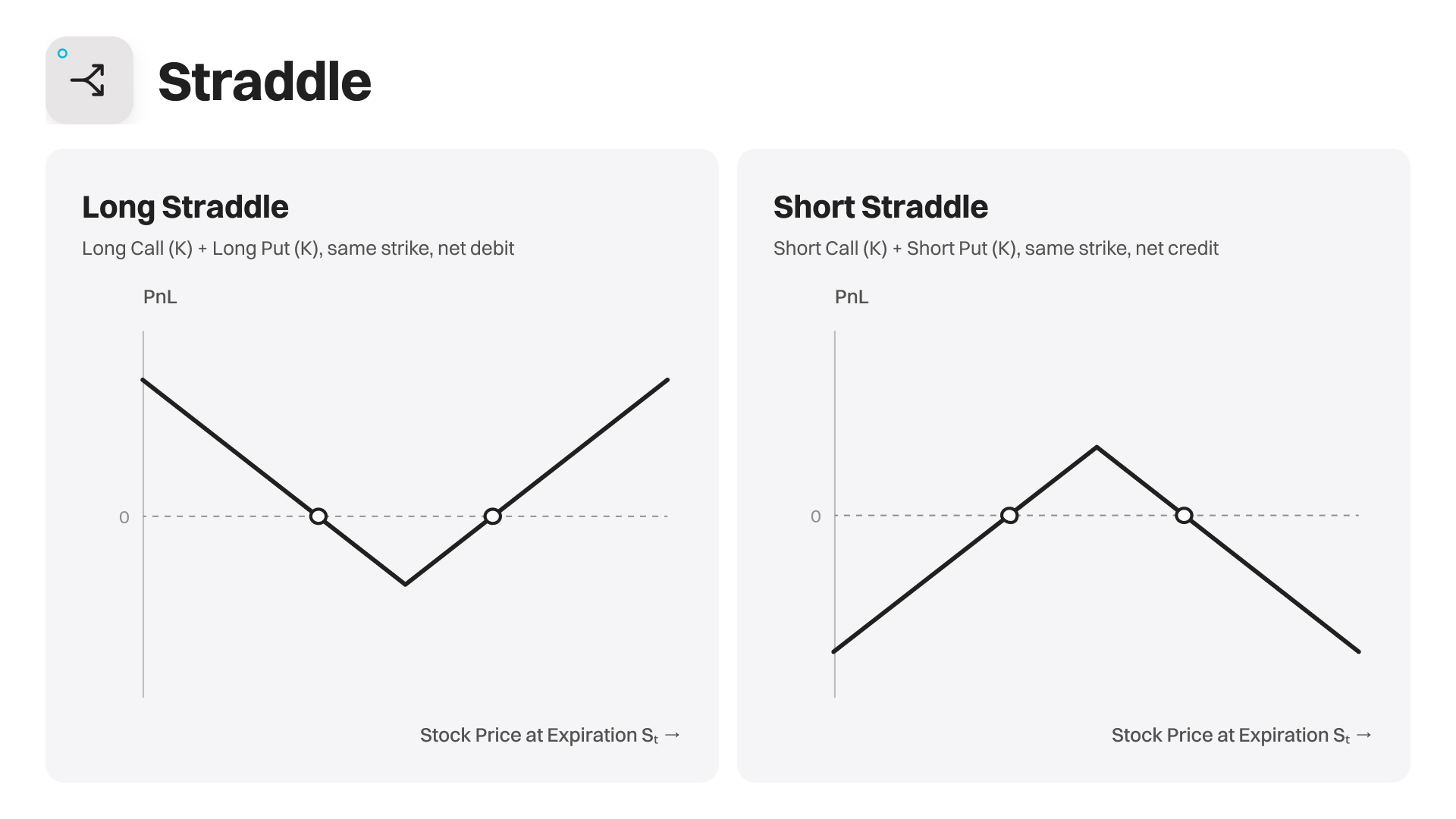
Straddles are the long straddle and the short straddle.
-
Long straddle: buy a call and a put with the same strike price and expiration date. Suits an expectation of a large move with no clear direction. For example, with the stock at $100, buying the 100 call and the 100 put may produce a profit if the price moves far enough in either direction.
-
Short straddle: sell a call and a put with the same strike price and expiration date. Better suited to an expectation that the price stays range-bound, but the risk of loss is significantly higher.
Strangles
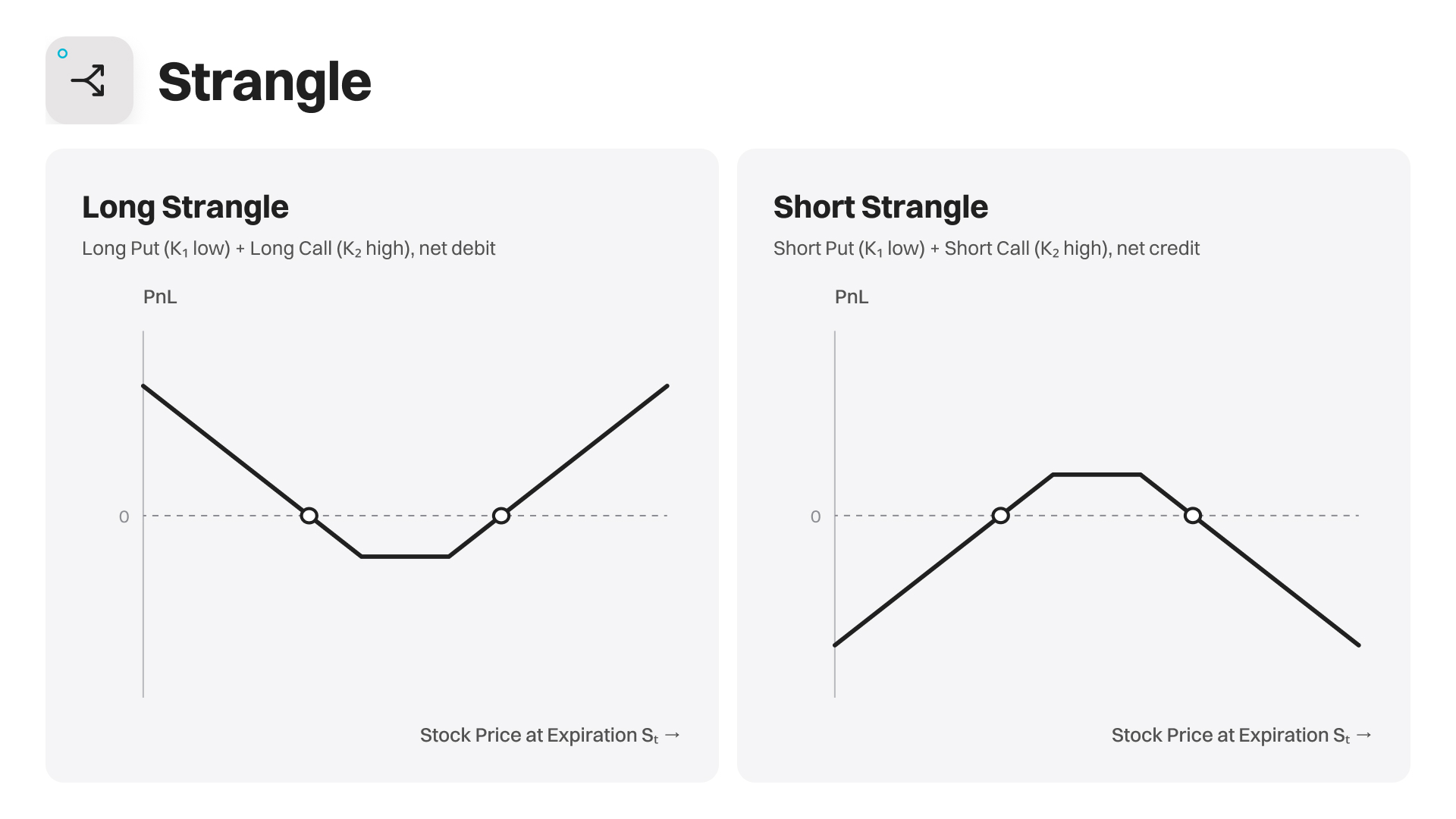
Strangles are the long strangle and the short strangle. They are similar to straddles, but the call and the put use different strikes, with the call strike usually above the put strike.
-
Long strangle: buy a higher-strike call and a lower-strike put. Suits an expectation of a large move with no clear direction.
-
Short strangle: sell a higher-strike call and a lower-strike put. Better suited to an expectation that the price will stay within a range, but it carries higher tail risk.
For example, with the stock at $100, you could buy the 105 call and the 95 put. Because both options are usually out of the money, a long strangle typically costs less to open than a long straddle, but it needs a larger move to become profitable.
2. Margin comparison: traditional U.S. stock options versus Bitget options
| Aspect |
U.S. stock options at traditional brokers |
Bitget Stock+ multi-leg options |
| Margin calculation |
Depends on the broker's rules, such as Regulation T (Reg T) or portfolio margin. Hedged combinations can reduce margin requirements. |
Supports portfolio margin, which calculates margin on the risk of the position as a whole. Hedged combinations can reduce margin requirements. |
| Trading commission |
Varies by broker. Some charge a commission per contract, while others offer commission-free trading. |
We currently charge no trading commission on U.S. stock options. |
| Platform and third-party fees |
May include platform fees and other related fees, such as SEC, FINRA, and OCC fees, depending on the broker and the type of trade. |
A platform fee applies separately, and other related fees may also apply, such as SEC, TAF, ORF, OCC, clearing, and CAT fees. |
| Trading hours |
Regular trading hours are typically 9:30 AM–4:00 PM (ET), though some brokers or products also offer extended-hours trading. |
We currently support multi-leg strategies only during regular trading hours, 9:30 AM–4:00 PM (ET). |
| Settlement and delivery |
U.S. stock options typically settle on T+1, and exercise generally results in delivery of the underlying shares. |
T+1 settlement, consistent with the U.S. stock market. In-the-money options at expiration are exercised and settled according to account assets and platform rules. |
3. Multi-leg strategies in practice
High-IV mega-cap tech and AI leaders (earnings season and event-driven)
The implied volatility (IV) of options on tech giants (the Magnificent 7) and AI-related stocks is extremely high around earnings releases and ahead of tech conferences. Buying a single option outright leaves you highly exposed to IV crush losses, so a multi-leg structure is the more robust choice.
Names to watch: NVDA (NVIDIA), TSLA (Tesla), AMD, AAPL (Apple), AMZN (Amazon)
Applicable strategies:
1. Bull call spread
Suits investors who are optimistic about the earnings results and expect the stock price to rise moderately. It works by buying a lower-strike call while selling a higher-strike call, which lowers the cost of establishing the position.
For example, with the stock at $100, you buy the 100 call for $7 and sell the 110 call for $3, which makes the net cost $4 per share. If the stock is at or above $110 at expiration, the maximum profit is $6. If it falls to $100 or below, the maximum loss is $4. The breakeven point is $104. The structure lowers the cost of buying the option, but the upside is capped.
2. Long straddle
Suits situations where you expect earnings to trigger a sharp move but can't be sure of the direction. Buy a call and a put at the same time, with the same strike price and expiration date.
For example, with the stock at $100, you buy the 100 call and the 100 put for a combined premium of $11. The breakeven points at expiration are $89 and $111. If the stock rises to $120 or falls to $80, you make $9 per share either way.
Note that elevated IV before the earnings release raises the cost of establishing the position, and the post-earnings IV crush can reduce the value of the options. The actual move has to be large enough to cover the premium paid.
3. Long collar
Suits investors who hold NVDA or AAPL shares for the long term and want to guard against a drawdown over earnings season. Buying a put provides downside protection, while selling a call collects premium that offsets part of the cost of that protection.
For example, you hold shares trading at $100, buy the 90 put, and sell the 110 call. If the stock falls below $90, the put can offset further losses on the shares. If it rises above $110, any additional upside is capped.
This strategy sets up a relatively well-defined price protection range for an existing stock position. The actual cost and the final PnL depend on the net premium of the two options.


- 1. Multi-leg basics
- 2. Margin comparison: traditional U.S. stock options versus Bitget options
- 3. Multi-leg strategies in practice