
Blue Owl Stock Falls on $48M Exposure to Failed U.K. Lender

Blue Owl Capital Inc. OWL shares declined more than 3% in the pre-market trading on Friday after a Bloomberg report highlighted the firm’s financial exposure to a failed U.K. property lender. The alternative asset manager reportedly has a £36-million ($48-million) exposure to London-based Century Capital Partners, which recently entered administration.
Century Capital, a bridging lender focused on high-end property in central London, collapsed with roughly £95 million in total debt. The firm relied on funding lines from private credit firms and banks to originate short-term property loans, typically extended to borrowers unable to secure traditional bank financing. These loans often carried higher interest rates due to their elevated risk profile.
According to people familiar with the matter, Blue Owl financed the riskiest tranche of loans issued by Century Capital.
While creditors have not accused Century Capital of fraud, its collapse came only days before another U.K. bridging lender, Market Financial Solutions, fell into a form of insolvency, intensifying concerns about the stability of the private property lending market.
Are Concerns Rising for Blue Owl?
This development has further fueled scrutiny of Blue Owl, which manages about $307 billion in assets and provides investors with exposure to private credit and direct lending strategies. The firm has already been facing questions from investors in 2026 amid liquidity pressures and operational changes.
Last month, OWL moved to restrict investor withdrawals from one of its retail-focused funds, an action that reverberated across alternative asset managers and reignited debate over liquidity, valuation transparency and systemic risks.
Blue Owl said that it stopped offering quarterly redemption opportunities for Blue Owl Capital Corp. II (OBDC II) and instead will return capital through periodic distributions funded by loan repayments, asset sales or other strategic transactions. Under the previous tender offer structure, investors could typically redeem up to 5% of their holdings each quarter. Blue Owl’s new plan does not offer that quarterly redemption window.
The company also disclosed a sale of $1.4 billion in direct lending assets across three funds, including about $600 million from OBDC II, with proceeds intended to fund investor payouts and help manage debt across the business.
What Drove This Decision of Blue Owl?
The decision follows rising redemption requests and mounting liquidity pressure within the private credit markets. OBDC II saw elevated redemption activity in 2025, with withdrawals rising roughly 20% year over year and running above historical norms. Sustained exit demand against a portfolio of illiquid, privately negotiated loans raised concerns that maintaining quarterly redemptions could eventually force payout limits if cash reserves proved insufficient.
Private credit funds like OBDC II lend to companies outside public bond and equity markets. These loans are less liquid and more difficult to sell quickly at transparent prices. If many investors seek to exit simultaneously, managers may need to sell assets at unfavorable terms or restructure liquidity provisions.
OWL’s Price Performance & Zacks Rank
In the past six months, OWL shares have lost 46.9% compared with the industry’s 19.6% decline.
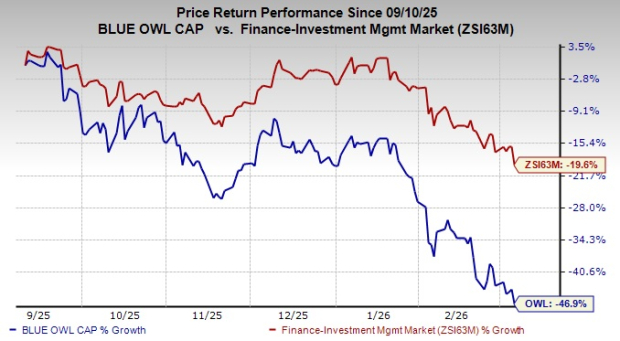
Image Source: Zacks Investment Research
Currently, Blue Owl carries a Zacks Rank #4 (Sell).
A couple of better-ranked stocks from the same space are Ameriprise Financial, Inc. AMP and Federated Hermes, Inc. FHI. Currently, AMP and FHI carry a Zacks Rank #2 (Buy). You can see the complete list of today’s Zacks #1 Rank (Strong Buy) stocks here.
The Zacks Consensus Estimate for AMP’s current-year earnings has been revised marginally upward over the past 30 days. Shares of Ameriprise have lost 3.2% in the past year.
The Zacks Consensus Estimate for FHI’s current-year earnings has been unchanged over the past 30 days. Shares of Federated Hermes have gained 44.2% in the past year.
Disclaimer: The content of this article solely reflects the author's opinion and does not represent the platform in any capacity. This article is not intended to serve as a reference for making investment decisions.
You may also like
Nifty 50 Is Still Down 4.91% in 2026, So Why Does Citi See 13% Upside?

US Dollar Index: Fed path and CPI focus – Deutsche Bank
 VIPMidterm Elections Conclude, Anthropic Initiates IPO
1. Cross-asset performance diverged this week. Between the October 30 and November 6 closes, the S&P 500 fell 2.68%, the Nasdaq 100 dropped 4.91%, and BTC lost 1.88%. Gold and silver rose 4.51% and 5.79%, respectively, while the Hang Seng gained 5.10%. Sharp declines in crude oil and some Asian equity indexes showed how differently assets responded to growth, policy, and event risks. 2. Democrats won majorities in both chambers of Congress in the US midterm elections, and markets rallied before reversing. We focus on actual changes in fiscal negotiations, key committee arrangements, and local industrial policy, especially data-center approvals, energy costs, and the pace of capital expenditure. We do not map party outcomes directly to asset direction. 3. The pullback in technology stocks has put returns on AI investment under renewed scrutiny. Whether rapid growth can cover financing, construction, and ongoing compute costs is becoming a key valuation test. For related positions, monitor policy implementation, customer capital expenditure, and cash collection together, and do not read a one-day rebound as a sign that the pressure has passed. 4. Anthropic's IPO preparations are putting the growth quality, operating profitability, and funding needs of AI model companies under public-market scrutiny. Valuations discussed for the offering are not final pricing, and participating in related products also requires assessing fees, allocation methods, asset rights, and trading restrictions. Assets in focus: BTC, the Nasdaq 100, crude oil, and gold, along with key earnings from companies including CSCO, AMAT, and CEG

Asian Stocks Rebound, Nikkei Up 3.4%, but Can They Lead Wall Street?

Crypto prices
More


