
Bio Protocol launches AI research hub to challenge grant gatekeepers

Bio Protocol has launched OpenLabs, a platform that combines AI-assisted research development, community funding, and on-chain governance as its ecosystem surpasses $33 million in capital raised.
- Bio Protocol launched OpenLabs, combining AI-assisted research development, collaboration, and funding in one platform.
- Researchers can seek funding through community voting, with BIO token holders participating in governance decisions.
- Bio Protocol said its BIO Genesis initiative has raised over $33 million to support decentralized science projects.
According to Bio Protocol, the platform was introduced on June 19 during DeSci.Berlin 2026, an event held at KÖNIG GALERIE as part of Berlin Blockchain Week.
The project said OpenLabs is designed to let researchers develop scientific ideas, coordinate with contributors, and seek funding through a single interface rather than relying on separate grant applications, governance platforms, and collaboration tools.
At the event, Bio Protocol presented OpenLabs as an alternative to traditional research funding processes, which often involve lengthy review cycles and institutional oversight. The project stated that community members can vote on research proposals while AI-powered workflows assist researchers in developing and refining projects.
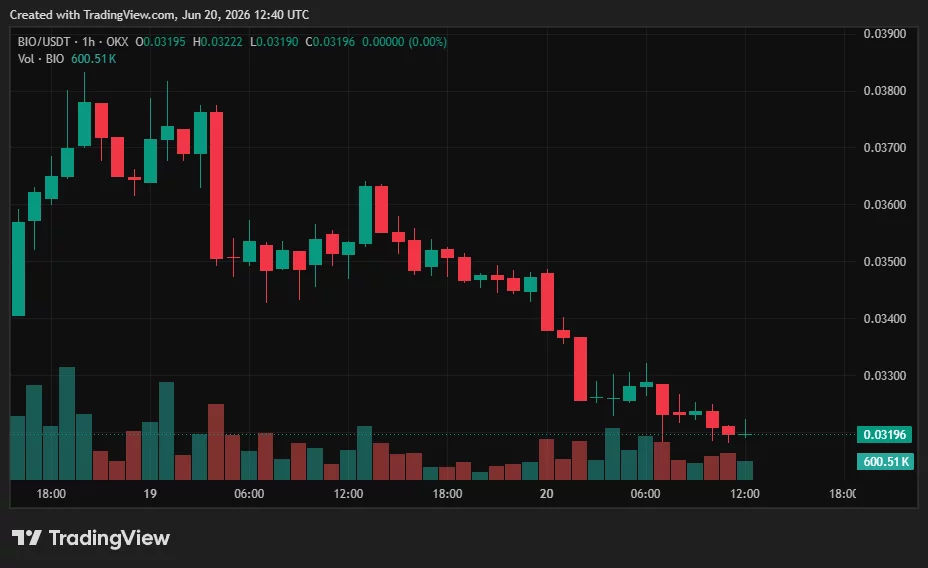
Despite the launch, Bio Protocol (BIO) continued to trade lower alongside the broader crypto market. The token declined more than 8% in the past 24 hours as investors assessed the hawkish tone adopted by Federal Reserve Chair Kevin Warsh and uncertainty surrounding the implementation of the proposed U.S.-Iran peace framework.
 Bio Proto
OpenLabs combines research collaboration with funding decisions
Under the model described by Bio Protocol, researchers and community participants work within the same platform where project development and funding decisions occur. The BIO token functions as the governance and utility asset used in voting and ecosystem participation.
Bio Protocol highlighted two projects during the launch. According to the team, RheumaAI is being developed as an AI agent focused on rheumatology research, while PeptAI is focused on peptide discovery.
The project stated that OpenLabs integrates AI-driven processes into scientific collaboration while allowing token holders and community members to participate in funding decisions. Rather than relying solely on traditional grant committees, project proposals can be reviewed and supported through community governance mechanisms built into the platform.
DeSci.Berlin has previously served as a venue for decentralized science initiatives. According to Bio Protocol, earlier editions of the conference helped incubate projects, including Molecule Labs.
Bio Protocol expands its decentralized science infrastructure
OpenLabs forms part of Bio Protocol’s existing decentralized science strategy. According to the project, it has been developing infrastructure that uses tokenized intellectual property and BioDAOs to direct funding toward biotechnology and scientific research programs.
Bio Protocol said its BIO Genesis initiative has raised more than $33 million to date. The project describes BIO Genesis as a fundraising mechanism that supports research-focused organizations operating within its ecosystem.
Bio Protocol’s work with AI research tools predates OpenLabs. In August 2025, the project launched the Ignition Sale for Aubrai, a decentralized BioAgent developed with VitaDAO for longevity research. According to Bio Protocol, Aubrai functions as an on-chain AI co-scientist capable of generating hypotheses and helping design laboratory experiments.
According to Bio Protocol, the decentralized science sector seeks to apply blockchain-based systems to research funding, governance, and intellectual property management. Supporters of the model argue that transparent funding records and community participation can provide alternatives to conventional research financing structures.
Regulatory questions remain a potential challenge as these models evolve. Tokenized intellectual property tied to biotechnology projects intersects with securities regulations, patent frameworks, and pharmaceutical oversight requirements.
As research programs progress from early-stage concepts to commercial development, legal and compliance obligations could become more complex for projects operating in the decentralized science sector.
Disclaimer: The content of this article solely reflects the author's opinion and does not represent the platform in any capacity. This article is not intended to serve as a reference for making investment decisions.
You may also like
TSMC (TSM.US) Q3 Conference Call: Customer demand is extremely strong and far exceeds supply; capital expenditures for 2026-2028 will be significantly higher than the previous three years
TSMC released its Q3 2026 financial report on Thursday and held an earnings conference call.

Institutions: HBM Expected to Increase in Price by 80%–100% in Q1 Next Year, Long-term Storage Contracts May Be Locked Until 2035
KeyBanc analyst Vinh believes that storage suppliers are significantly shifting capacity towards data centers, and next year, PC and mobile storage supply will drop sharply by 20%-30%. In Q4 this year, both DRAM and NAND are expected to surge by more than 15%. HP and Dell have extended supply agreements until 2031, and Google is negotiating long-term agreements covering up to 2035.

Why Is NEAR Up 10%? Four Protocol Catalysts Behind the 30-Day 120% Rally

Crypto prices
More


