
20cm Makes a Comeback! Is Applovin's "Gaming Foundation" Still Stable?


AppLovin (APP.US) delivered a “spectacular turnaround” in Q3, mainly because investor sentiment was cautious ahead of the earnings report, but the actual results exceeded expectations, with growth momentum reversing and showing a slight re-acceleration.
The main points are as follows:
1. Growth Returns to Acceleration
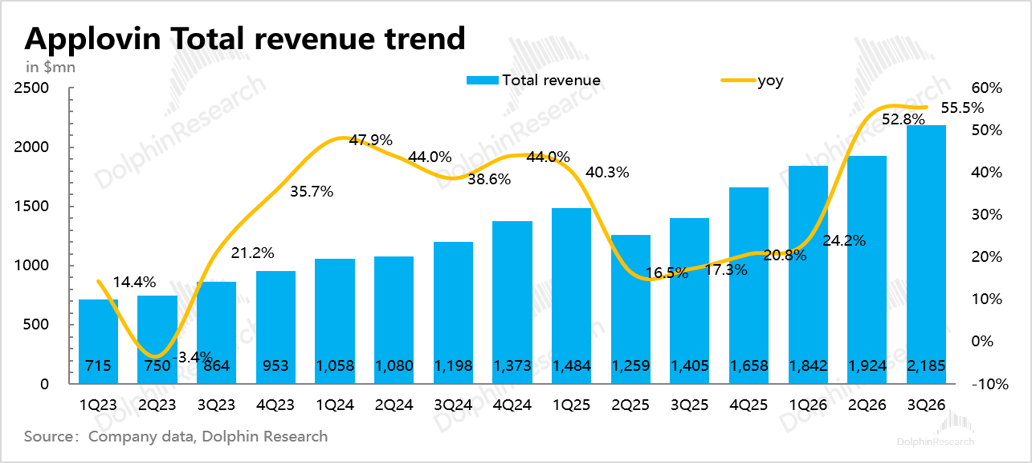
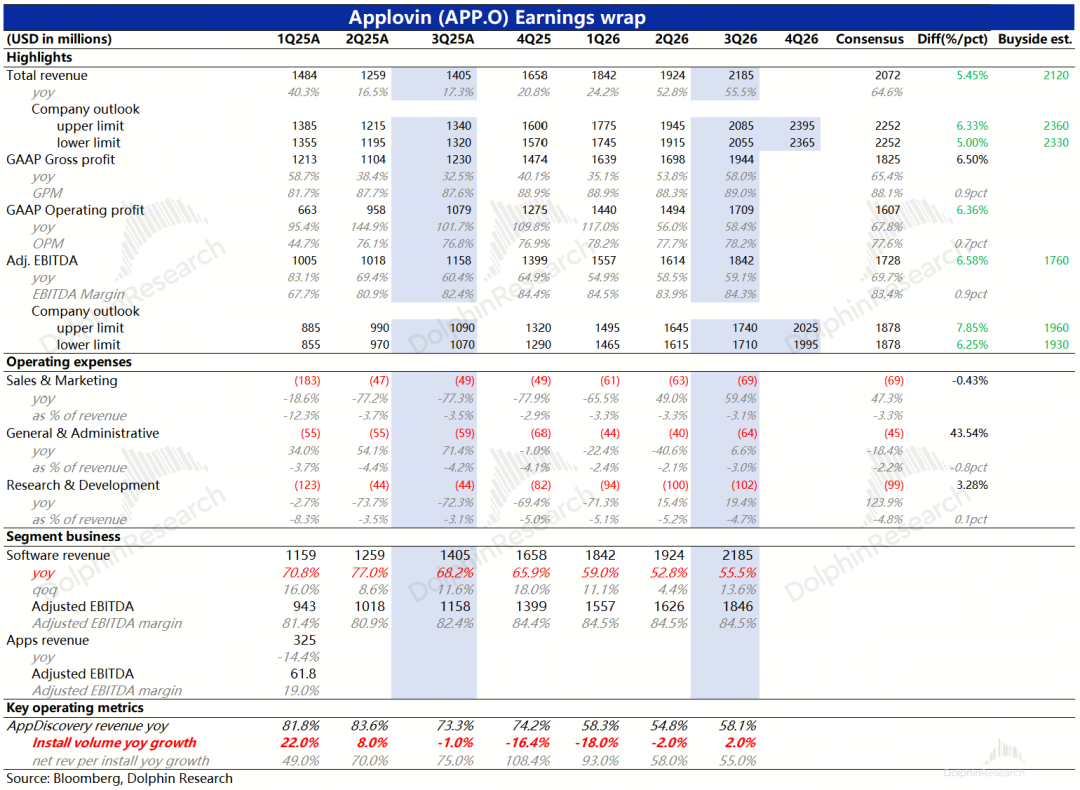
Q3 revenue was $2.2 billion, up 13.6% quarter-on-quarter, a significant improvement over the previous quarter's growth rate, returning Applovin to its familiar growth range.
Revenue for the period exceeded sell-side and buy-side expectations. Q4 guidance implies the growth rate will slow to 45% off a high base, but this is still higher than the market’s previous Q4 growth expectation of about 36%.
2. Gaming Ad Recovery
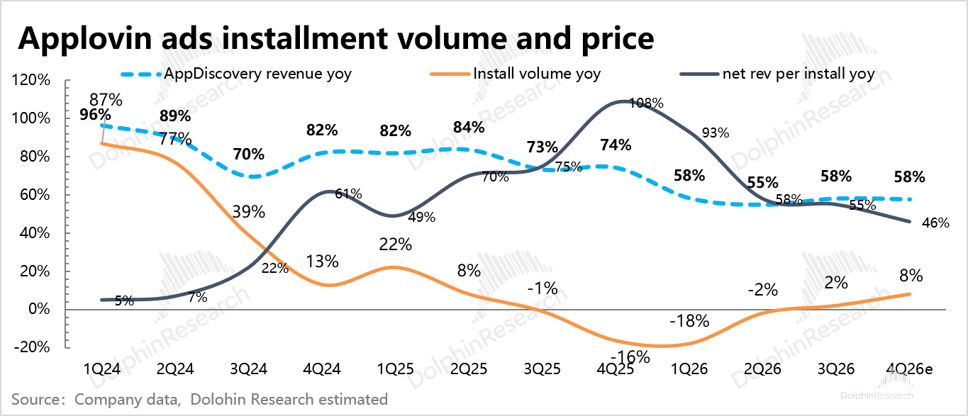
Q3 app installs finally returned to positive growth, up 2% year-on-year. Revenue per install accelerated 55%; although this slowed slightly quarter-on-quarter, it remains at a high level. Volume and price combined indicate that app download ad revenue (mainly gaming ads) increased by 58%, a slight acceleration versus Q2.
According to Q4 guidance, Dolphin estimates Q4 volume and price changes will continue Q3 trends: installs up, but unit price growth slowing (estimates for reference only).
Ahead of earnings, research feedback suggested Applovin's gaming ad market share was dropping (partly due to high pricing and competitors expanding penetration, leading clients to allocate budget to rival platforms for test campaigns). In addition, ROAS under the post-July upgraded model showed no significant improvement, so the capital sentiment—already cautious due to litigation risks—remained vigilant, wary of a repeat Q2 shock.
So, even though alternative data showed Max installs kept accelerating in Q3, the market was still overly concerned about increased penetration from competitor Unity and the comeback attempt from Meta.
The reality was, after Applovin rolled out its new model, advertisers resumed their spend, andthe growth of the app ad industry (driven by AI Overview penetration, which forced promotional spending to shift from web to app) offset Applovin’s market-share loss, with absolute revenue growth exceeding market expectations.

3. E-commerce Advertising Still in Early Stages
The company did not disclose e-commerce ad revenue, likely because it's still too small. Institutional research found e-commerce ad progress lagging previous expectations, with average conversion efficiency.
Dolphin estimates that if gaming revenue grew about 48–50% year-on-year and net e-commerce revenue doubled, Q3 e-commerce revenue would be around $310–$410 million, accounting for 14–19% of total revenue.
With AI Agent development, e-commerce platforms’ own acquisition channels may be eroded, potentially increasing traffic buying. Whether Applovin can seize this opportunity remains to be seen, especially regarding improvements in conversion efficiency.
4. Profit Margin Slightly Recovers
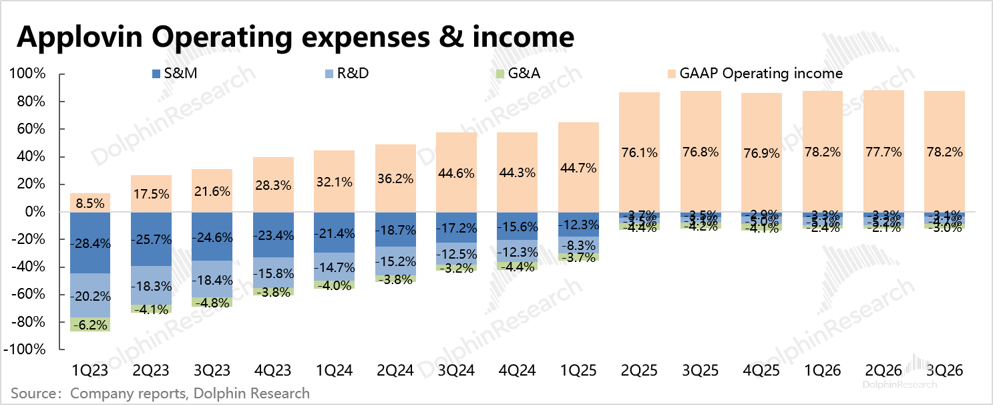
In Q3, year-on-year costs for marketing and R&D continued to increase significantly.
Sales expenses were mainly linked to Axon’s self-service platform opening up to e-commerce advertisers and acquiring new users;
Most of the R&D increase came from employee SBC (stock-based compensation) grants (in October 2025, 920,000 PSUs granted to some key non-executive IT engineers, vesting if market cap targets are hit, expected to be phased in over two years on a quarterly basis), with normalized growth excluding this factor at 19%.
Quarter-on-quarter, the main change in Q3 was a nearly $20 million increase in admin expenses, disclosed as professional service costs (Dolphin speculates these relate to the September securities litigation and accusations over Unity collecting data).
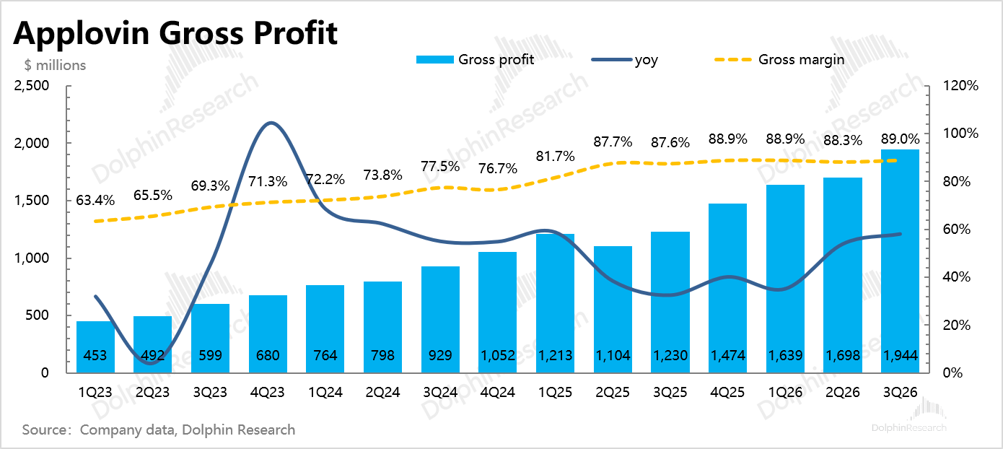
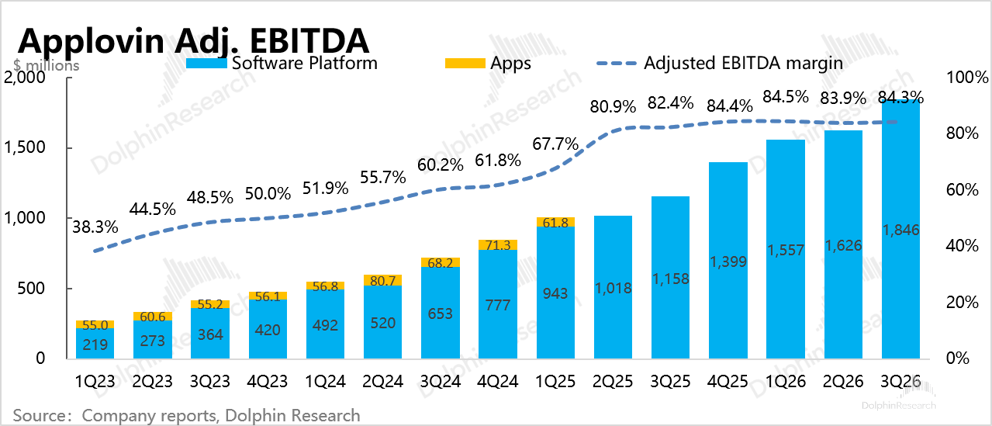
Ultimately, strong revenue offset expense increases, with GAAP operating margins up 0.5 percentage points quarter-on-quarter. Excluding the above SBC factor, Adj. EBITDA margins in Q3 recovered to 84%; Q4 guidance indicates margins should hold steady quarter-on-quarter.
5. Buybacks in Full Force
In Q3, $1.4 billion was repurchased at an average price of $339/share, 2.5 times the previous quarter and roughly equal to all of Q3’s free cash flow. The board added $3.2 billion in new authorization, bringing total authorization to $3.6 billion by the end of October, about 3% of the after-hours market cap.
The company currently holds $3.2 billion in cash, and quarterly free cash flow remains around $1.5 billion, so a $1 billion buyback per quarter is easily manageable. The current $3.6 billion limit could be used up in 3–4 quarters. If the limit is renewed in future, the next year’s $4 billion buyback pace would represent about 4.4% of yesterday’s market cap ($90.9 billion).
6. Key Metrics Overview
Dolphin’s View
Last quarter’s rout was partly due to the model upgrade timing. Even though Dolphin felt the sell-off was excessive, the market continued to test the downside for a full quarter, reflecting panic that Applovin’s core fundamentals and growth momentum had peaked and would weaken.
Thus, the biggest surprise of the Q3 results is that it alleviated concerns about Applovin’s pillar—mobile gaming ads—shoring up the valuation floor.
Though market share indeed contracted (Unity’s first year in the market and Meta’s return with an AI boost has strong momentum), Applovin has been the market leader for years due to its superior ROAS, and its technical moat is not so easily eroded.
But with price increases peaking, the follow-up volume-driven strategy will bring Applovin into more direct competition with strengthening rivals. Perhaps seeing pressure from competitors, Applovin has already sued Unity, accusing it of collecting its ad tracking data without permission.
Gaming ads are the foundation, but e-commerce ads are key to whether Applovin can scale up in the future. Third-party research currently shows only moderate progress—early growth was mostly from advertisers’ experimental campaigns. However, as these test campaigns yielded low conversion, it directly affects advertisers’ willingness to allocate budget for formal campaigns in the future.
On the earnings call, management still did not quantify much progress with e-commerce ad revenue, saying only that quarterly e-commerce ad growth was in double digits quarter-on-quarter and triple digits year-on-year, and hinted that e-commerce ad contributions are becoming significant rather than negligible.
- END -
/// Repost permitted

The article isn’t easy to write, click“Share” to give me some energy~
Disclaimer: The content of this article solely reflects the author's opinion and does not represent the platform in any capacity. This article is not intended to serve as a reference for making investment decisions.
You may also like
Goldman Sachs 2027 Macro Outlook: Global Economy to Accelerate Slightly, but the Path Remains Rocky and Downside Risks Cannot Be Ignored
Goldman Sachs expects global GDP growth to rise from 2.7% in 2026 to 2.8% in 2027, with energy price shocks shifting from a headwind to a tailwind, and AI investment remaining the main growth driver. The three major downside risks stem from energy impacts related to the Iran situation, the bond market, and the AI cycle. Annual inflation is expected to decline, though upside risks persist. The Federal Reserve is projected to raise rates once each in December and March 2027, while the European Central Bank is expected to begin rate cuts in December 2027 and Q4, respectively. Both equities and bonds are expected to generate positive returns in 2027, though volatility risks are increasing, and returns on commodities are expected to be close to zero.

AI Cloud Service Provider Nscale Sees Surging Debt Before IPO, Increasing Dependence on Nvidia (NVDA.US) for Funding and Chip Supply
In its latest regulatory filing submitted prior to its initial public offering, Nscale disclosed that the company's debt level has risen significantly, and it will need to raise substantial funds in the future to fulfill customer contracts. Additionally, Nscale's dependence on Nvidia is higher than previously disclosed.
Besent and Federal Reserve Officials Clash: Is Inflation Caused by Energy Shocks or Overheated Demand? Debate Intensifies Over Fed Rate Hike Path
U.S. Treasury Secretary Besent believes the current inflation primarily stems from energy supply shocks triggered by the Iran war, and considers the current inflation data to be essentially "noise," stating that the Federal Reserve should not raise interest rates because of it. However, Chicago Federal Reserve President Goolsbee argues that inflation has now spread to sectors including services and healthcare, and warns that the risk of overheated demand cannot be ignored, indicating that the Federal Reserve still needs to take action.
Flare Extends Its Data Infrastructure to LayerZero With New DVN

Crypto prices
More


